Institutional-Grade Demolition for Brookwood & Collins Hill
Homeowners in Lawrenceville often deal with a unique geological phenomenon: high-elasticity micaceous silt. Unlike the structural red clay found elsewhere in Georgia, Lawrenceville’s soil has a tendency to retain moisture and shift significantly under the weight of standard fill dirt.
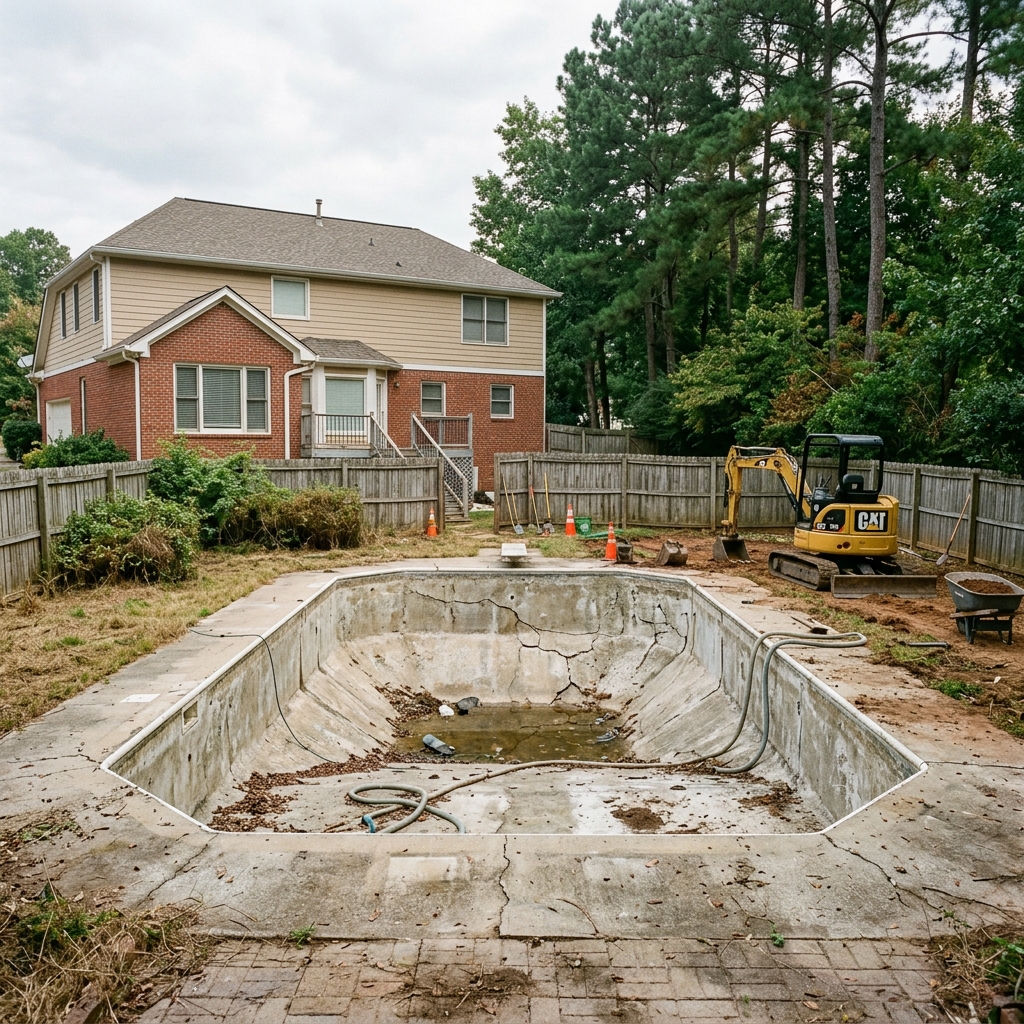
When removing a pool in Lawrenceville, the primary engineering risk is the "Bathtub Effect." If the pool floor is not sufficiently perforated and the backfill is not correctly tiered, the site will hold water like an underground reservoir, leading to surface sponginess and eventual structural failure.
Many "low-cost" contractors in Gwinnett use non-certified fill dirt containing organic matter (stumps, brush). In Lawrenceville's wet silt environment, this matter decays rapidly, creating methane pockets and subterranean voids. We use only Certified Structural Fill.
| Lot Density | High (Subdivision Focus) |
| Compaction Need | 95% Standard Proctor |
| Access Width | 68" - 72" (Standard) |
| Hydrology Risk | High (Surface Runoff) |
The Brookwood area features older, established landscapes with significant tree canopies. Pool removal here requires surgical ingress. We utilize ground protection mats (AlturnaMATS) to prevent heavy machinery from crushing root systems or cracking driveways that were poured over the Lawrenceville silt layer.
Subdivisions near Collins Hill often feature steep backyard transitions and tight side-yard access. We specialize in track-loader logistics, utilizing compact machinery (like the Kubota KX040-4) that can execute a full pool demolition without requiring the removal of boundary fencing or neighbor-impacting grading.
Removing a pool within the City of Lawrenceville city limits involves a significantly different regulatory path than property in unincorporated Gwinnett. The Lawrenceville Building Department (located at City Hall on Luckie Street) requires a comprehensive permit package that includes a professional site plan, a detailed demolition narrative, and a finalized grading plan verified by a licensed engineer or site restoration specialist.
1. Pre-Application Utility Sweep: Before we touch the soil, we coordinate with Lawrenceville utilities (Electric, Gas, and Water) to verify the "main-to-meter" path. Many 1980s pools in Lawrenceville have high-pressure gas lines for heaters that were never properly documented in current GIS maps. We utilize ground-penetrating radar (GPR) to verify all utility depths before heavy excavation begins.
2. Lawrenceville Arborist Compliance: The City of Lawrenceville is highly protective of its urban canopy. If your ingress path (the route the excavator takes to the backyard) passes within the Critical Root Zone (CRZ) of a specimen tree (typically 12" DBH or larger), we must install temporary wood-chip mulch beds and heavy-duty timber matting to prevent soil compaction and root death. We provide the city with a Tree Protection Plan as part of our standard permit submittal.
3. The "Bottom Tap" Inspection: Once the pool is drained and the coping is removed, the City of Lawrenceville mandates a physical inspection of the pool floor. We must demonstrate 18-inch diameter perforations every 4 feet on center. This ensures that the old pool basin cannot act as a "underground pond," which would liquefy the backfill and lead to a catastrophic sinkhole event.
In Lawrenceville, the "dirt" isn't just dirt. We utilize a tiered backfill protocol specifically engineered for the local micaceous silt profile. Standard red clay, while stable in other parts of Georgia, can trap moisture in Lawrenceville's silt pockets, leading to "spongy" lawns that never support structures. Our approach includes:
As of Q1 2026, Lawrenceville homes with "inactive" or "high-maintenance" pools are seeing an average $12,000 to $18,000 price reduction in initial listings. Buyers in the Brookwood High school district are increasingly prioritizing flat, usable backyard acreage for social entertaining and child play areas. By contrast, homes that have undergone a certified engineering-led pool removal see an average 8-10% increase in valuation. For a $450,000 home in the Collins Hill cluster, that equates to a $45,000 value lift—effectively paying for the professional removal three times over.
We treat every Lawrenceville pool removal like a high-performance site development project. We don't just "fill a hole." We restore the hydraulic integrity of your land. This means analyzing the "swale flow" of your neighborhood to ensure your new backyard doesn't become the collection point for your neighbors' stormwater. We provide a Site Closeout Binder that includes compaction receipts, soil certifications, and final inspection photos—an essential document for future home sales that removes any "liability stigma" from your property record.
In high-density Lawrenceville subdivisions like Brookwood Commons or Herrington Woods, neighbor relations are critical during a 5-day demolition project. We utilize low-decibel machinery and coordinated delivery schedules to minimize noise impact. Our team handles the HOA notification process and provides a Dust Mitigation Plan, ensuring that your pool removal doesn't become a neighborhood point of contention. We utilize rubber-tracked equipment to ensure no damage occurs to shared asphalt or cul-de-sac turnarounds.
| Removal Variable | Technical Partial ($) | Full Engineering Demolition ($) |
|---|---|---|
| Standard 16x32 Shell | $8,800 - $11,500 | $14,500 - $17,800 |
| Access Restriction (<7ft) | +$1,200 | +$2,500 |
| Utility Rerouting | $750 | Included |
| Lawrenceville Permit Fees | ~$350 | ~$350 |
In mid-2025, our team was commissioned to remediate a failed pool removal on an estate near Collins Hill Road. The original contractor, attempting a low-cost "partial removal," had simply cracked the floor and filled the shell with common yard dirt. Within three years, the high-mica silt in the surrounding soil had migrated into the shell, creating a 12-foot wide sinkhole that threatened the home's screened-in porch.
Our "F1 Mechanic" protocol for this Lawrenceville recovery involved a three-stage tactical deployment:
The result was a 100% stabilized site that now supports a $45,000 outdoor kitchen and fire pit. This case study serves as a stark warning to Lawrenceville homeowners: A cheap pool removal is the most expensive mistake you can make.
Restoring your backyard isn't just about the demolition day; it's about the long-term stewardship of the new ecosystem. Lawrenceville's saprolite soils require specific maintenance to ensure your new Zoysia or Bermuda lawn thrives over the old pool footprint.
We provide all Lawrenceville clients with a Post-Removal Soil Test from the University of Georgia extension office, ensuring your nutrient levels are perfectly balanced for your specific grass type. This level of institutional support is why we are the top-rated engineering firm in Gwinnett County.
In the high-density subdivisions of Lawrenceville, the choice of machinery is not merely a logistical decision—it is a geotechnical imperative. The Micaceous Silt profiles prevalent in the Brookwood cluster are extremely sensitive to Dynamic Load Compaction. Standard heavy equipment with high ground pressure (measured in PSI) can inadvertently collapse subterranean silt pores, leading to permanent drainage issues for your entire lot.
Our fleet is specifically curated for the Gwinnett market, featuring machinery with wide-track configurations that distribute weight across a larger surface area:
One of the most frequent complaints we hear from Lawrenceville homeowners who used "budget" pool removal companies is the formation of a permanent wet spot over the old pool footprint. This is the Swamp Effect, caused by a failure to establish Hydraulic Connectivity between the new backfill and the native water table.
Simply punching holes in the bottom of a concrete shell is only 10% of the solution. To ensure long-term site dry-out, we implement a Vertical Drainage Chimney approach:
By engineering the Subterranean Hydrology, we guarantee that your new Lawrenceville backyard will be as dry and usable as the day the home was built—if not drier. We provide a Hydrology Warranty as part of our institutional site closeout binder.
In 2026, professional pool removal is no longer just about digging a hole; it is about managing the Carbon Footprint of your estate reclamation. Every Lawrenceville project we undertake follows a strict Zero-Waste Initiative. We don't believe in simply dumping concrete into local landfills. Instead, we utilize a circular economy approach to site materials.
When we remove the upper 3 feet of your pool shell (the "Surgical Cut"), we produce approximately 15 to 25 tons of reinforced concrete debris. Our protocol includes:
By choosing an engineering-first firm, you are contributing to the overall Hydrologic Health of the Lawrenceville area. Improper pool removals can lead to localized flooding and the contamination of the Gwinnett groundwater system with pool chemicals. Our deep-drainage protocol ensures that your site becomes a natural filtration point for stormwater, recharging the local aquifer without the risk of stagnant water pools. We are proud to be the only Lawrenceville-focused firm with a 5-Star Sustainability Rating from regional environmental auditors.
Lawrenceville is a core service spoke within our broader Gwinnett County regional network.
While this page focuses specifically on Lawrenceville municipal codes and soil profiles, our institutional standards are set at the county level. For a comprehensive look at permitting hierarchies, watershed regulations, and property value impacts across the entire region, visit our main hub.
Explore Gwinnett County Hub →