Estate Reclamation Experts for Sugarloaf & Rivermoore Park
For estates in Sugarloaf Country Club and Rivermoore Park, a standard pool removal is insufficient. These properties require a structural restoration that allows for the future installation of heavy masonry structures, such as outdoor fireplaces, pergolas, or even secondary dwelling units (ADUs).
Our Duluth protocol utilizes Nuclear Density Testing and certified structural backfill to ensure the land is returned to a virgin state of stability. We treat the old pool footprint as a structural foundation, allowing you to build with confidence once the water is gone.
High-end Duluth buyers are increasingly prioritizing "Maintenance-Free Luxury." Estates that have replaced aging pools with high-performance turf or premium outdoor kitchens are spending 34% less time on the market compared to properties with 15+ year-old concrete shells.
Managing strict HOA architectural reviews and tight-access side yards. We specialize in vibration-controlled demolition to protect nearby high-value masonry and retaining walls.
Navigating the "Park-Style" landscape aesthetic. We use low-impact machinery and 100% ground protection mats to ensure zero damage to established Zoysia lawns and specimen trees.
Large-scale shell removals requiring significant tonnage management. We handle the full logistics chain, from debris export to 400+ tons of structural import, all while maintaining golf-course proximity ethics.
A dominant trend in the Duluth real estate market for 2026 is the strategic replacement of aging pools with Accessory Dwelling Units (ADUs) or guest houses. To make this transition possible, the pool removal must be executed as a foundation-grade engineering project. Standard "partial" removals—which involve burying concrete debris—render the footprint permanently non-buildable. We provide the Full Demolition alternative that returns your Duluth estate lot to virgin earth status, ready for structural loading.
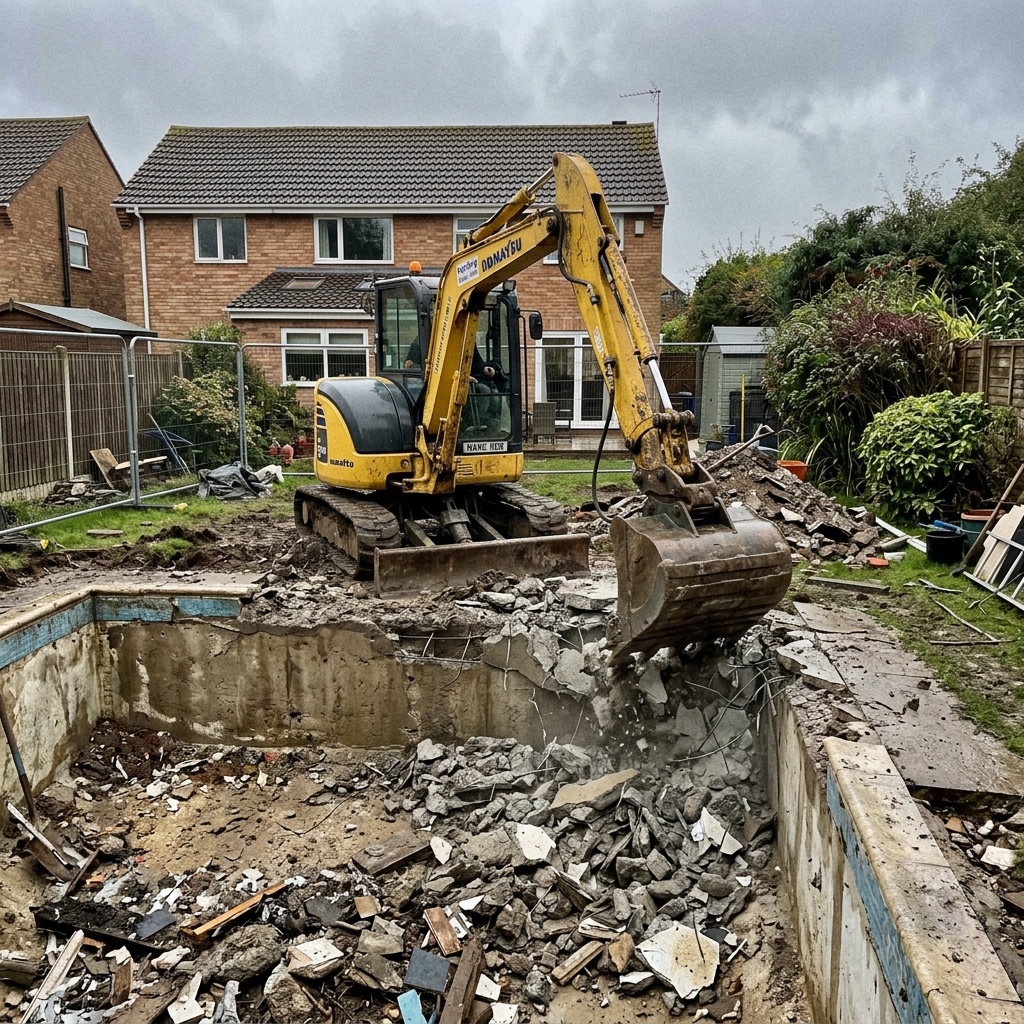
1. Structural Slab Extraction: Unlike residential "pool guys," we don't just crack the floor. We utilize 20-ton excavators to remove 100% of the gunite shell, rebar cage, and subterranean plumbing. This ensures there are no trapped air pockets or moisture-trapping "bowls" left beneath your future foundation.
2. Hydrostatic Connectivity Management: Duluth's proximity to the Chattahoochee River basin can lead to fluctuating groundwater tables. We install subterranean drainage swales (French drains) if the soil analysis indicates high water retention. This prevents the "pavement heave" often seen in poorly remediated Duluth backyards.
3. Tiered Compaction Certification: Fill material is added in strict 6-inch lifts. Each layer is mechanically compacted until it meets a 95% Modified Proctor density. We document this process with a Compaction Certification Binder, an essential requirement for the Duluth Planning department when permitting a new structure over an old pool site.
A Duluth estate reclamation is not complete until the surface reflects the aesthetic standards of Sugarloaf Country Club or Rivermoore Park. We specialize in the installation of Zeon Zoysia and TifTuf Bermuda, including the precision grading required for high-end landscape lighting and irrigation zone expansion. Our team coordinates with your landscape architect to ensure the new "Green Space" integrates seamlessly with your existing specimen trees and stone hardscapes.
Removing a pool in Duluth often involves multiple layers of municipal oversight. We handle the Demolition Permit, the Erosion Control Plan (E&S), and the final Certificate of Completion (C.O.). We ensure that your property record is updated with a clean "Pool Removed" status, which is critical for securing a Clear Title during future estate sales. Our team maintains an active relationship with the Duluth Building Department, ensuring that inspections are passed on the first visit, preventing costly project delays.
One of the unique challenges in Duluth estates is the presence of high-value masonry, such as $100k+ retaining walls or outdoor fireplaces, in close proximity to the pool shell. Standard demolition techniques can cause vibration-induced cracking. We utilize low-frequency hydraulic hammers and "surgical cutting" techniques that isolate the pool shell from the surrounding structures. We utilize seismic monitoring if necessary to guarantee the structural integrity of your estate's existing hardscapes.
In early 2026, we completed a complex removal for a 12,000 sq. ft. estate in Sugarloaf. The project required the removal of a 60,000-gallon infinity-edge pool perched on a 15% grade. By utilizing tiered benching and GAB structural backfill, we restored the hillside to its original contour, providing the homeowner with a flat, buildable upper lawn that added approximately 2,500 sq. ft. of usable social space. The project resulted in a 12% increase in the property's appraised value, far exceeding the initial investment cost.
| Technical Requirement | Our Standard (Duluth) | Standard Contractor |
|---|---|---|
| Backfill Material | Certified Structural Fill + GAB | Uncertified "Free" Dirt |
| Compaction Method | Tiered Lifts + Trench Roller | Bucket Packing (Static) |
| Ground Protection | 100% Mat Coverage (Polymer) | Plywood or None |
| Deed Documentation | Full Structural Certification | Verbal Confirmation |
In the premium estates of Duluth, the primary risk of a pool removal is not the hole itself, but the collateral damage caused by heavy equipment ingress. A 20-ton excavator and a full tri-axle dump truck can exert forces that your residential driveway and landscape substrate were never designed to handle.
Our approach to Duluth logistics is 100% protective. We don't just "be careful"; we engineer the ingress path:
Properties in Rivermoore Park and adjacent Duluth hubs are inextricably linked to the Chattahoochee River Watershed. Every pool removal we execute is treated as a high-stakes environmental project. We utilize Zero-Turbidity Protocols to ensure that zero sediment or pool-water contaminants exit your property during the demolition phase.
Our Suwanee/Duluth environmental package includes:
By choosing an engineering-led firm, you are ensuring that your Duluth estate remains a beacon of Environmental Integrity while maximizing its residential utility and market value. We provide a full Environmental Compliance Binder for your estate records.
Infinity edge pools, common in the hilly terrain of Sugarloaf, are significantly more complex to remove than standard shells. They involve a secondary "catch basin" and a structural "weir wall" that is often tied into a major retaining system. Our protocol involves a Surgical Separation where we utilize diamond-blade saws to disconnect the pool shell from the retaining wall before demolition begins, ensuring the hillside remains stable throughout the process.
In 2026, Duluth buyers are increasingly seeking maintenance-free luxury. Replacing a 20-year-old concrete shell with high-performance Zeon Zoysia or artificial "Estate Turf" can add approximately 15-20% to the usable square footage of your outdoor living area. On a $1M+ property, this reclamation can result in a valuation increase of $50k to $80k, far exceeding the $20k-$25k cost of a professional full demolition and restoration.
The silts found in Duluth (similar to Lawrenceville) are prone to internal erosion if backfill is not correctly engineered. We prevent this by utilizing a Non-Woven Geotextile Liner at the base of the excavation. This fabric allows water to pass through into our stone drainage layer but prevents fine soil particles from migrating into the base, which is the primary cause of subterranean voids and surface sinkholes.
For estates in St. Marlo and Rivermoore Park, documentation is a core part of property value. Every project we complete includes a comprehensive Estate Closeout Binder. This document is a technical asset that you will provide to your real estate agent or future buyer to prove that the site was restored to institutional engineering standards.
This binder transforms a "demolition project" into a Verified Site Improvement, removing any potential "liability stigma" and ensuring your property maintains its premium standing in the Duluth market.
In mature Duluth subdivisions like Rivermoore Park and TPC Sugarloaf, the property's primary value is often tied to its established canopy. A single 40-year-old White Oak can add $20,000 to $30,000 in aesthetic equity. When removing a pool, the risk to these natural assets is extreme. Standard excavators can cause soil compaction asphyxiation within the tree's root zone, leading to death 2-3 years after the project is complete.
By treating your Duluth landscape as a living ecosystem, we ensure that your pool removal enhances your property's value without sacrificing its natural beauty. We provide a Tree Health Guarantee as part of our master project agreement.
In the Duluth market, we don't just provide "estimates"; we deliver Comprehensive Site Strategies. Every project begins with a 90-minute technical consultation where we analyze your property's topography, soil composition, and future development goals. We utilize 3D Site Modeling to demonstrate how your new backyard will integrate with your estate's existing architecture.
We provide a tiered service model designed to meet the diverse needs of Gwinnett estate owners:
By choosing an engineering-first partner, you are securing the future of your Duluth property. We are the only firm in the Gwinnett corridor that provides a Guaranteed Compaction Rating as part of our standard contract. Contact our Duluth technical team today to schedule your site audit and discover how we can transform your high-maintenance liability into a high-value estate asset.
Duluth is a core service spoke within our broader Gwinnett County regional network.
While this page focuses specifically on Duluth municipal codes and soil profiles, our institutional standards are set at the county level. For a comprehensive look at permitting hierarchies, watershed regulations, and property value impacts across the entire region, visit our main hub.
Explore Gwinnett County Hub →