Many homeowners in the Atlanta metropolitan area find themselves asking a critical question: "Is removing my pool worth the investment?" Whether you're in Sandy Springs, Decatur, or Marietta, the decision to remove a pool is often a combination of financial practicality and a desire for more usable space.
In 2026, the cost of pool maintenance—including electricity, chemicals, and staffing for regular cleanings—has reached new levels. For many, the pool that was once a source of joy has become a source of frustration and liability. Here’s a closer look at the factors that tilt the scales toward removal.
The Financial Reality of Atlanta Pool Ownership in 2026
Many homeowners underestimate the true cost of keeping a pool active. Let's break down the actual operational and maintenance expenses faced by a typical homeowner in Fulton, Cobb, or DeKalb County:
- Utility Costs: Running a standard filtration pump for 10 to 12 hours a day during the hot Georgia summer months adds $120 to $180 per month to your electric bill. Water evaporation and filter backwashing also lead to higher water utility bills.
- Chemicals & Cleanings: Chlorine, stabilizers, algaecides, and acid cost between $80 and $150 per month. If you hire a professional pool service to clean the pool weekly, that adds another $150 to $250 per month.
- Equipment Lifecycle Depreciation: Pool machinery has a limited lifespan. Replacing a pump motor costs $800 to $1,500; replacing a sand or DE filter costs $1,200; and replacing a gas pool heater averages $3,500. Additionally, concrete and gunite pool shells require structural resurfacing (plaster or pebble-tec) every 8 to 10 years, which costs between $10,000 and $15,000.
- Insurance Premiums: Homeowners insurance providers view swimming pools as high-liability features. Maintaining a pool often increases your liability coverage premiums.
When you combine these items, maintaining a pool costs between $2,500 and $4,000 annually. Since a professional pool removal in Atlanta costs between $10,000 and $18,500 as a one-time expense, the project pays for itself within three to five years, yielding substantial long-term savings.
Reclaiming Space: The Value of Land vs. Water
Property values in communities like Sandy Springs, Marietta, and Decatur have climbed significantly. Reclaiming 1,500 to 2,500 square feet of backyard space expands the usability of your property. In Northern Georgia, swimming pools are only comfortable for about 4 to 5 months of the year (mid-May through September). For the remaining 7 months, the pool sits covered as a liability that still requires chemical monitoring and winterizing maintenance.
Removing the pool allows homeowners to transform their backyards. Once the basin is backfilled and compacted, the area becomes a blank canvas for multi-level patios, outdoor kitchens, fireplaces, native gardens, and open sod lawns where children and pets can play safely. In addition, DeKalb and Fulton county zoning rules allow homeowners to construct Accessory Dwelling Units (ADUs), detached carriage houses, or detached home offices over fully engineered pool removal sites, providing a way to add square footage and value to your home.
Safety and Liability: Peace of Mind
For families with young children, active pets, or elderly parents, an unused pool is a source of constant anxiety. Swimming pools are a leading cause of accidental backyard injuries. Safety fences and pool alarms help reduce risks, but they require constant maintenance and do not completely eliminate the liability. Removing the pool eliminates this hazard completely, giving homeowners peace of mind and reducing potential home insurance liability claims.
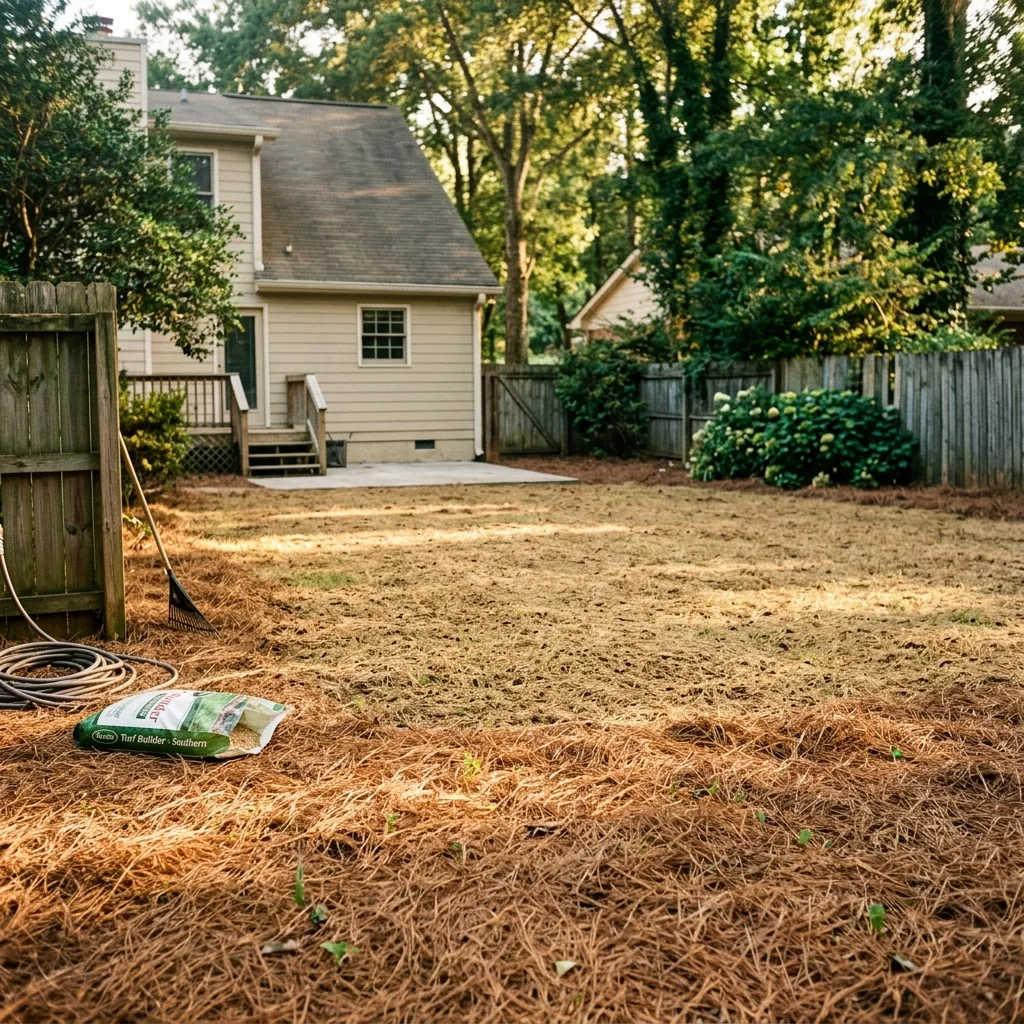
A high-value yard restoration in Sandy Springs, GA.
Demolition Options: Balancing Budget and Future Land Use
If you decide that pool removal is the right path, you have two primary methods to choose from, each with distinct structural and financial trade-offs:
Option A: Partial Demolition (Abandonment)
This is a budget-friendly method where the pool structure is deactivated but not entirely removed. Our crew fractures the bottom of the concrete basin to prevent it from holding water underground, collapses the top 2 to 3 feet of the pool walls inward, and fills the remaining void with soil. While this method costs between $7,500 and $12,500, it leaves a permanent underground obstruction. Under Georgia real estate disclosure laws, this abandonment must be disclosed to future home buyers. Future construction over this area is limited to lawns or gardens; you cannot build permanent structures like patios, decks, or additions over a partially filled pool.
Option B: Full Engineered Removal
In a full removal, we extract all concrete, gunite, structural steel rebar, PVC plumbing, and filtration equipment from the property. The void is then backfilled with clean, structural sandy clay loam imported from local quarries. The soil is placed in thin 6-to-8-inch lifts and compacted to 95% Modified Proctor density (ASTM D698). A licensed geotechnical engineer monitors the compaction and issues a certified compaction report. This method costs between $10,000 and $18,500, but it completely restores your property's structural integrity, allowing for unrestricted building clearance and ensuring a clean title for future home resale.
Ecological Impact & Environmental Benefits
Beyond the financial return on investment (ROI), removing a pool offers significant ecological benefits. A standard 20,000-gallon pool loses around 10,000 to 15,000 gallons of water to evaporation annually, requiring constant tap water replenishment. Furthermore, sand and DE filters rely on backwashing, which discharges chlorinated water containing chemical residues into the soil or municipal stormwater systems. By removing the pool, homeowners can replace it with a native plant garden, grass lawn, or organic mulch beds. This restores the yard's permeability, allowing rainwater to recharge local aquifers rather than running off into storm sewers. Choosing native North Georgia flora (like switchgrass, coneflowers, and redbuds) creates a habitat for local pollinators, supporting biodiversity.
The Permitting & Compaction Checklist for Homeowners
Before you make the final decision to hire a contractor, here is the essential checklist to verify if your contractor is doing the job right:
- County Permit Filing: Demolition permits must be filed with Cobb, Fulton, or DeKalb County before any equipment arrives on site.
- 811 Utility Locate: Coordinate with Georgia 811 to mark all public gas, water, and power lines.
- Erosion Control Setup: Install double-row Type C wire-backed silt fencing to contain red clay runoff.
- Rough Demolition Inspection: Schedule county check after concrete wall collapse and drainage hole punch.
- Geotechnical Proctor Testing: Licensed engineers must check soil density at every 6-to-8-inch lift, ensuring 95% Modified Proctor density.
- Final Site Stabilization: Grade, seed, and lay down straw blankets to prevent soil erosion.
Frequently Asked Questions (FAQ)
How does a pool removal impact my home insurance?
Most home insurance policies require a specific rider for swimming pools due to the liability of accidental drowning or injury. By removing the pool and submitting the permit closure certificate to your insurance provider, you can request the pool rider be removed. This typically lowers your premium and eliminates any future pool-related liability risk.
Does removing a pool lower my property tax assessment?
In many Georgia counties, a swimming pool is assessed as an improvement that adds taxable value to your property. Removing a pool can result in a downward adjustment of your property's assessed value, leading to annual property tax savings. We provide permit closure documentation to help you update your county tax assessor's records. This reduction is especially common in high-assessment areas like Buckhead and Sandy Springs where luxury improvements are taxed at a higher marginal rate.
How do we ensure the soil does not settle after backfilling?
Soil settling is prevented by avoiding loose fill dirt and organic matter. We import clean, quarry-certified structural fill loam and compact it in thin 6-to-8-inch layers (lifts) using walk-behind sheepsfoot rollers and vibratory compactors to achieve 95% Proctor density, matching the structural stability of the surrounding undisturbed ground.
Will I need to disclose a pool removal when selling my house?
Yes, if you choose a partial pool fill (abandonment), you must disclose the buried concrete debris on the Georgia Association of Realtors (GAR) Seller's Property Disclosure Statement. If you choose a full engineered removal, you receive a certified compaction report from a licensed engineer, confirming that all pool debris was extracted and the soil was compacted to engineering standards, providing proof of property integrity to buyers.